


 English
 中文
marketing@dgkaihang.com
Industry News


As AI compute clusters continue to scale, AI has evolved from an incremental demand driver for optical communications into a core force reshaping interconnect technologies, product architectures, and the evolution of the industry chain.
From September 20 to 24, 2026, the 52nd European Conference on Optical Communication (ECOC 2026) was held in Malaga, Spain. The conference offered multiple technical and industrial exchange programs including Plenary Session, Workshop, Tutorial, Invited Speakers, Market Focus, and Product Focus, with the exhibition running from September 21 to 23. According to official ECOC data, this edition attracted more than 340 exhibitors and over 8,000 industry attendees. [1]
Judging from the technical topics at this year's conference and exhibition, AI-driven demand has moved beyond simply raising line rates toward multi-dimensional constraints spanning bandwidth density, power consumption, latency, thermal management, reliability, and scaled deployment.
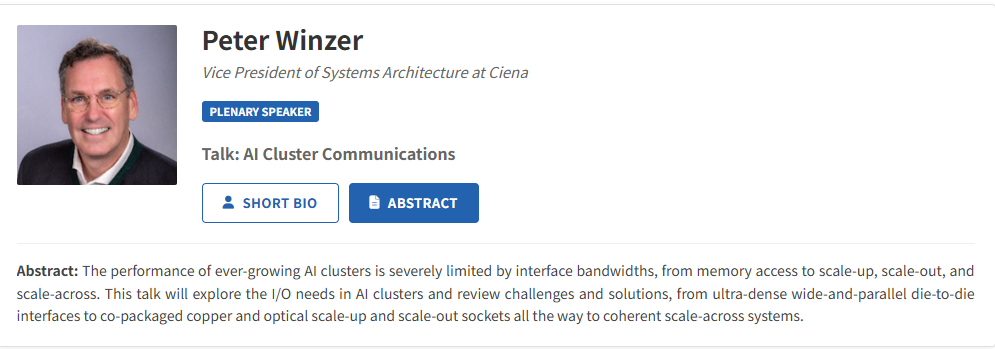
In his plenary talk "AI Cluster Communications," Peter Winzer, Vice President of Systems Architecture at Ciena, analyzed the interconnect requirements of AI clusters across three tiers: scale-up, scale-out, and scale-across. The official ECOC abstract states:
“The performance of ever-growing AI clusters is severely limited by interface bandwidths, from memory access to scale-up, scale-out, and scale-across.” [2]
| Interconnect Direction | Primary Connection Relationship | Technical Focus |
|---|---|---|
| Scale-up | Near-distance interconnect between accelerators, processors, memory | Bandwidth density, latency, power consumption, packaging, and chip-to-chip connection |
| Scale-out | Network expansion within servers, racks, and clusters | Switching capacity, optical module speed, network topology, and port density |
| Scale-across | Connection between different clusters, data centers, or compute resource domains | Long-distance transmission, network scheduling, reliability, and cross-domain expansion |
This shift has already begun to be transmitted to the industry supply side, with optical interconnect moving from "demand growth" into a phase of "simultaneous demand and supply expansion."
Morgan Stanley's meeting research with companies during ECOC 2026 shows that the capacity of most optical component and system suppliers for the next 12–18 months is essentially sold out, with the judgment that optical content growth in AI networks is faster than supply capability; meanwhile, supply pressure exists across InP substrates, EML, CW lasers, pump lasers, and gold-box packages. [3]
Therefore, what deserves attention at ECOC 2026 is not a single speed node, but how AI demand is propagating along the chain of "speed—architecture—components—materials—manufacturing—network" to various segments of the industry chain.
I. Background—AI Compute Expansion: Optical Interconnect Demand Shifts from Speed Growth to Bandwidth Density and Scale Expansion.
II. Underlying Channel Bottleneck—224G/448G Evolution: Per-Channel Bandwidth Improvement and High-Speed Electrical Link Constraints.
III. Architecture Solution Divergence—Electrical Bottleneck Drives Post-1.6T Architecture Divergence: NPO, CPO, XPO, and External Laser Parallel Evolution.
IV. Supply-Side Bottleneck—Demand Transmits Upstream: InP, EML, CW Lasers, and Advanced Materials Become Supply Constraints.
V. Engineering Industrialization Challenges—High-Density Deployment and New Networks: Connection, OCS, Testing, and Reliability Enter the Industrialization Phase.
VI. Top-Level Logic for Scale Deployment—From Scale-across to Open Ecosystem: Network Expansion and Standardization Jointly Drive Scale Deployment.
The continuous expansion of AI computing resources is driving interconnect demand simultaneously toward higher bandwidth, higher density, and larger connection scale.
Scale-up mainly involves high-bandwidth, low-latency connections between accelerators, processors, and memory; Scale-out further connects servers, racks, and AI clusters; Scale-across extends the interconnect scope to different clusters, data centers, and compute resource domains. [2]
The common feature of these three types of interconnect demand is that as computing scale expands, the amount of data that needs to be carried per unit of I/O, per unit of space, and per unit of power consumption continues to increase.
ECOC 2026 Market Focus incorporated 200G/lane, 1.6T PAM4, 800ZR/ZR+ alongside 400G/lane, 3.2T PAM4, and 1600ZR/ZR+ into the discussion of AI network technology evolution, and listed system cooling, power delivery, and signal integrity as important limiting factors for next-stage architecture selection. [4]
AI demand growth is further transmitting from the downstream network end to the optical component supply chain, with the supply-demand relationship becoming an important industry signal at ECOC 2026. Supply tightness is also pushing companies to lock in upstream resources in advance and expand manufacturing capacity.
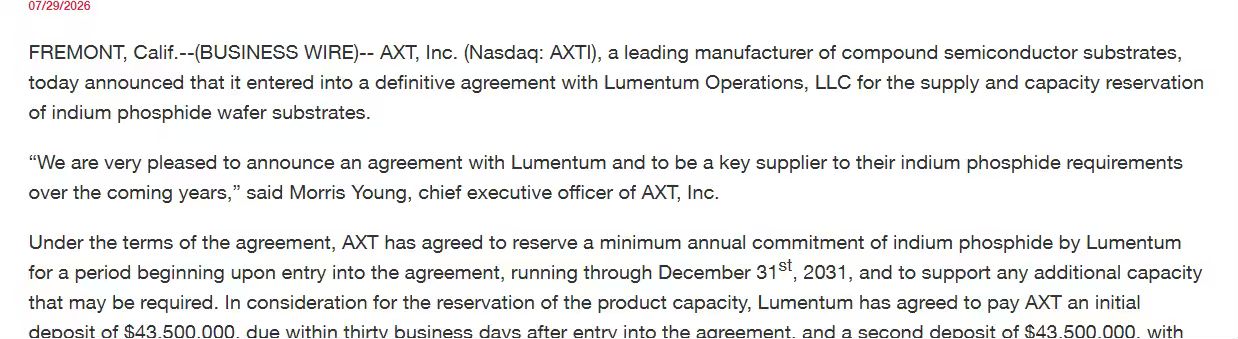
AXT announced in July 2026 that it signed a long-term InP wafer supply and capacity reservation agreement with Lumentum, with the agreement term extending to December 31, 2031. Lumentum paid an initial prepayment of $43.5 million for capacity reservation, with additional funding arrangements agreed upon. [5]
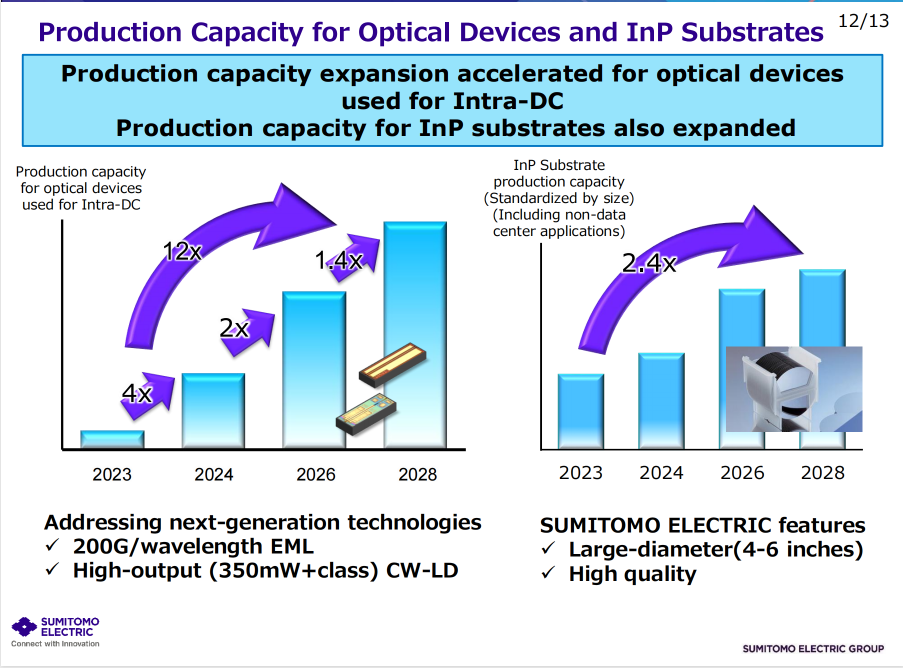
Sumitomo Electric's 2026 capacity plan likewise shows that AI data center demand is driving simultaneous expansion of InP substrates and optical components.
Sumitomo Electric plans to increase its InP substrate capacity by approximately 2.4 times from 2023 to 2028, while advancing 200G/wavelength EMLs and high-output CW lasers above 350mW for next-generation data center optical communications. [6]
From the demand side, what AI brings is no longer simply "higher speed," but rather the simultaneous requirement of high bandwidth density and large-scale deployment on the entire optical interconnect industry chain's supply capability.
When the number of I/Os and packaging space are limited, increasing per-channel speed is the most direct technical path to improving interconnect bandwidth density.
ECOC 2026 conducted multiple discussions around CEI-224G, CEI-448G, 200G/lane, and 400G/lane, covering high-speed SerDes, TIA, drivers, DSP, and PIC. [4]
Marvell is evolving toward 3.2T-class connections through 2nm 400G/lane optical PAM4, focusing on improving the bandwidth-carrying capacity per channel.
Marvell demonstrated 2nm 400G/lane optical PAM4, 2nm 800G ZR/ZR+, 2nm 1.6T ZR, and O-band coherent-lite technology at ECOC 2026, with the 400G/lane solution targeting 3.2T data center connections and 800G ZR/ZR+ targeting longer-distance connections in AI and cloud data centers. [7]
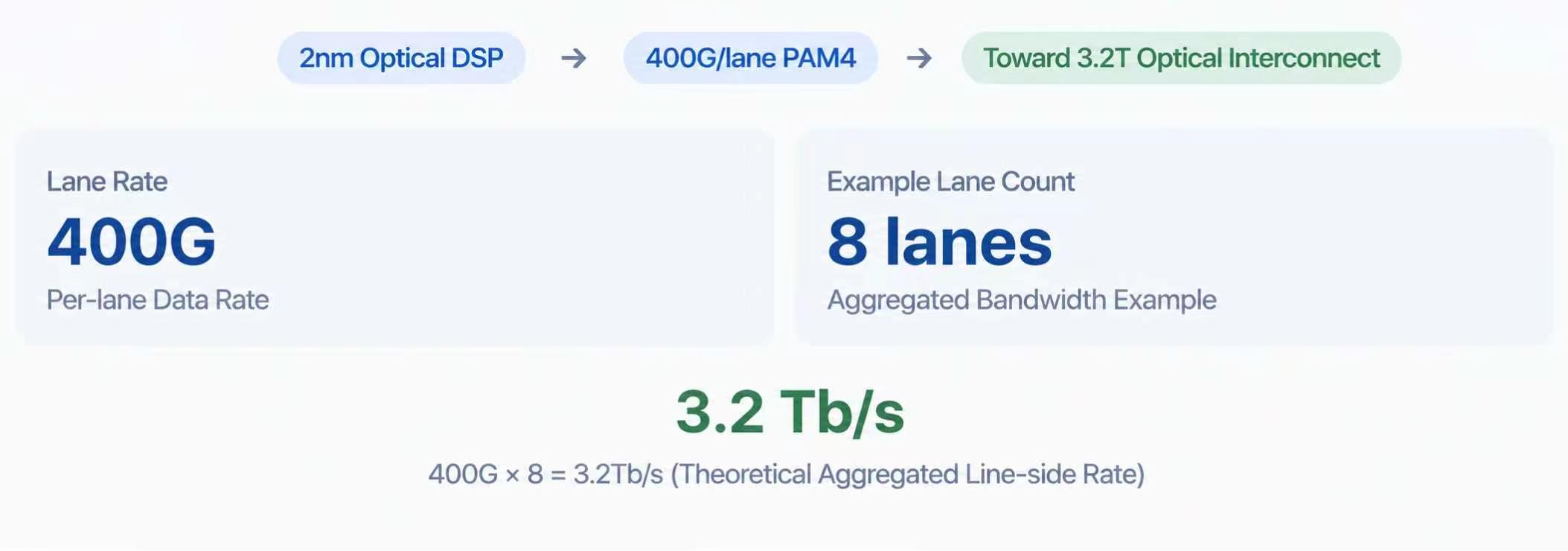
Note: This channel aggregation example is not equivalent to a complete commercial product specification.
Semtech and MACOM are continuing to advance 224G/448G device capabilities from high-speed analog front-end and optoelectronic chipset perspectives, respectively.
Semtech demonstrated 224Gbps/lane TIA and related high-speed devices; MACOM demonstrated 3.2T, 8×448Gbps PAM4 architecture chipsets for next-generation high-speed optical connections. [8][9]
As high-speed channels continue to improve, loss, crosstalk, packaging transitions, and material characteristics in electrical links begin to become more direct limiting factors.
The official ECOC agenda for 1600G+ explicitly lists crosstalk, insertion loss, packaging density, power efficiency, and thermal management as key issues, and discusses low-power DSP, high-speed front-end, and advanced cooling technologies. [4]
Many companies are simultaneously improving the overall integration of links from DSP, PIC, and new light source perspectives.
Credo demonstrated a 1.6T 2×DR4 fully retimed module at ECOC 2026, combining DSP with 200G silicon photonic PIC; Sicoya demonstrated 400G/lane PIC and 1.6T-class optical solutions; NewPhotonics demonstrated a 6.4T NPO chipset; and Avicena demonstrated a 335-channel microLED LightBundle eKit. [10][11]
These technologies indicate that per-channel speed increases are pushing design boundaries further from SerDes chips toward optoelectronic conversion and packaging layers. As per-lane speeds continue to increase, it becomes necessary to simultaneously control electrical path length, packaging transitions, optoelectronic conversion loss, and DSP power consumption. Therefore, 224G/448G is not an isolated speed node, but an important technical driver pushing optics closer to the chip.
As power consumption, distance, and signal integrity constraints of high-speed electrical channels become increasingly prominent, the industry has begun to improve bandwidth density by changing optical deployment positions and packaging forms.
The official ECOC 2026 Market Focus, themed "Crossroad again, what optics solution(s) will be prevailing for post 1.6T era?", brought NPO, CPO, CPX, XPO, 300/400G per lane, high-order modulation, and coherent-lite into the same technology route discussion. [4]
Compared with previous discussions primarily focused on technical feasibility, this year's ECOC discussions on NPO have clearly advanced toward product timelines and ecosystem conditions.
Morgan Stanley, in its post-ECOC 2026 survey, believes that market expectations for NPO adoption are clearer than during OFC, with the current phased judgment being that NPO will enter the initial product and trial cycle for some Scale-up networks around 2028; it also notes that first-generation NPO architecture may still undergo significant changes. [3]
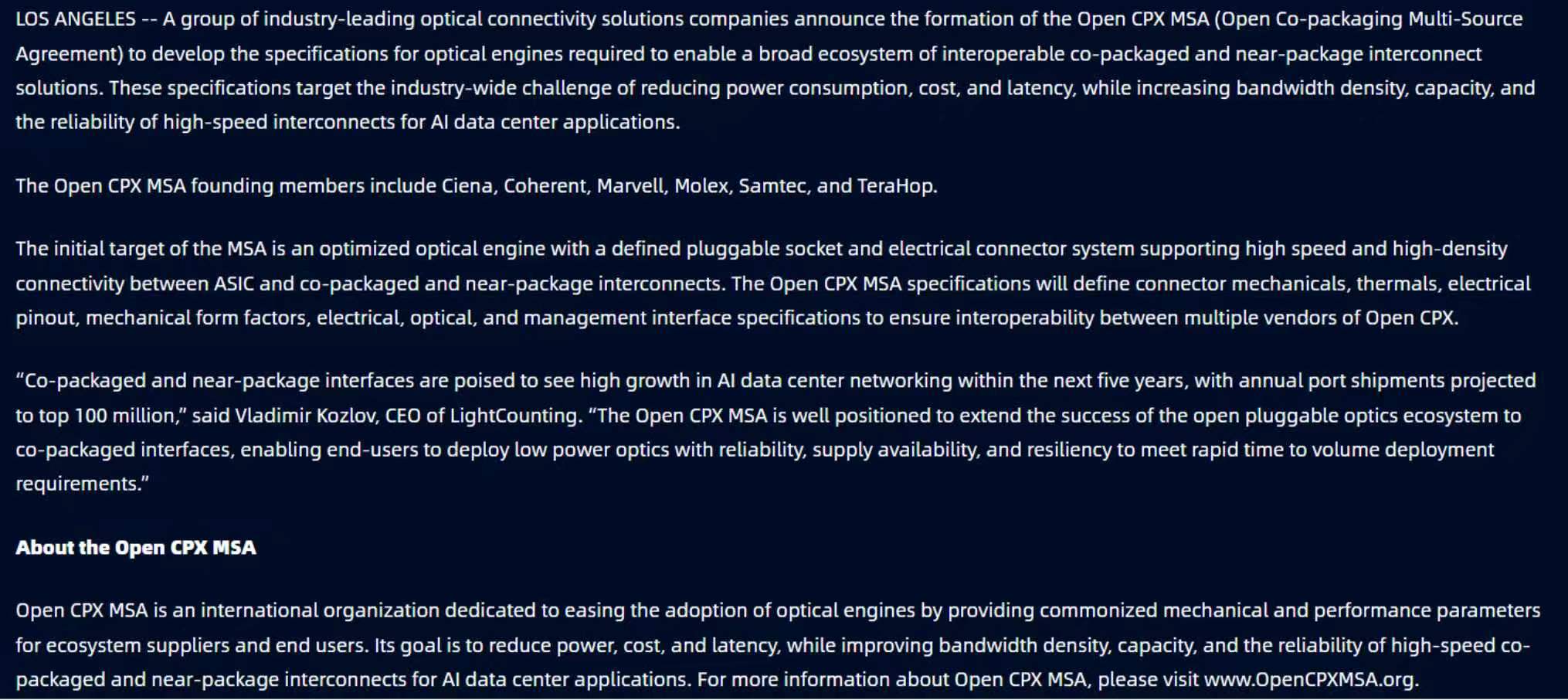
Open CPX is an important factor in driving NPO from single-vendor solutions toward an open ecosystem.
Open CPX was initiated by six founding members—Ciena, Coherent, Marvell, Molex, Samtec, and TeraHop—with the goal of establishing open, interoperable specifications for CPO/NPO optical engines, reducing system integration complexity through standardized sockets and electrical connector systems, and alleviating hyperscale customers' concerns about vendor lock-in. [12]
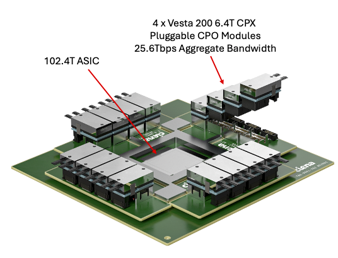
Ciena's Vesta 200 6.4T CPX demonstrates the specific implementation of open optical engines in terms of power consumption and maintenance.
Ciena's Vesta 200 employs a 200G/lane architecture and linear drive design, with system capacity exceeding 400T, and claims up to 70% lower power consumption compared to traditional data center optical interconnect; its standardized CPX pluggable form also accommodates repairability and flexible copper/optical interconnect configurations. [13]
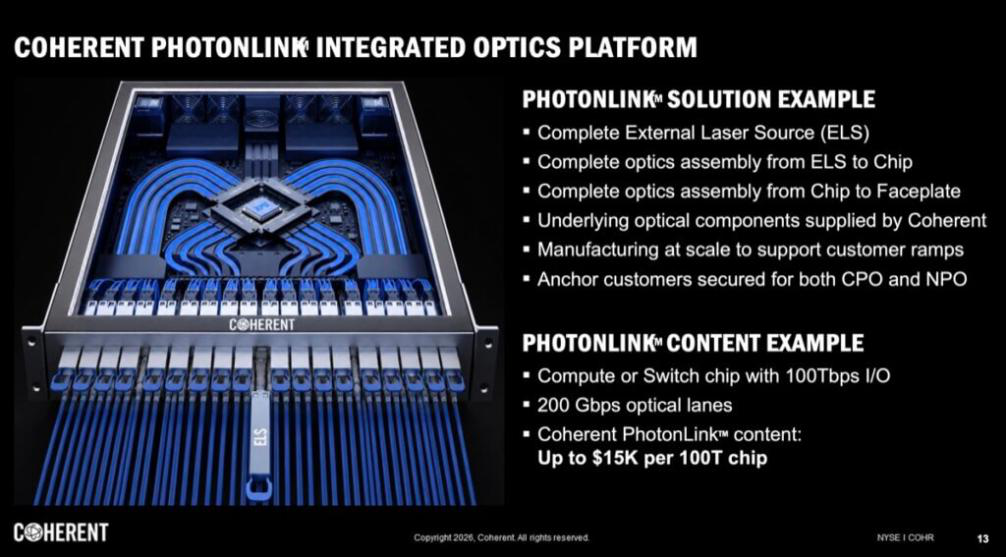
Coherent, meanwhile, uses PhotonLink to expand NPO from a single optical engine into an end-to-end optical platform.
At ECOC 2026, Coherent launched PhotonLink, covering CPO, NPO, and chip-to-chip connectivity, and integrating silicon photonics, FAUs, ELSFPs, InP CW lasers, VCSELs, TECs, and fiber assemblies into a unified platform. [14]
PhotonLink has already shown relatively clear customer, contract, and commercialization progress.
Coherent disclosed that PhotonLink currently has over 10 CPO customer projects, over 10 NPO customer projects, and over 5 chip-to-chip collaboration projects; its official investor materials further show that the NPO solution has an anchor customer and LTA, with production ramp-up in the second half of 2027. [15]
Coherent also provided the potential value of chip-level optical interconnect, offering a more specific reference for the commercial value of NPO/CPO.
In PhotonLink investor materials, Coherent used a 100Tbps I/O, 200G/lane application as an example, giving a Coherent content value of up to approximately $15,000 per 100Tbps I/O chip. [15]
"Scaling AI infrastructure requires more than bandwidth – it requires solving power, integration and thermal challenges together." [14]
This figure does not represent a single optical module price, but rather the extension of optical interconnect value from component combinations within modules toward complete optical integration solutions on the chip side.
Lumentum, for its part, enters NPO/CPO from the external-laser-source angle, decoupling high-power lasers from the high-temperature chip environment.
Lumentum showcased an 8-wavelength DWDM ELSFP module with two four-wavelength bands centered at approximately 1311nm and 1331nm, delivering up to about 24dBm (≈250mW) optical output power per wavelength; module power is about 12W when all eight channels operate simultaneously, and it leverages Lumentum's UHP laser platform. [16]
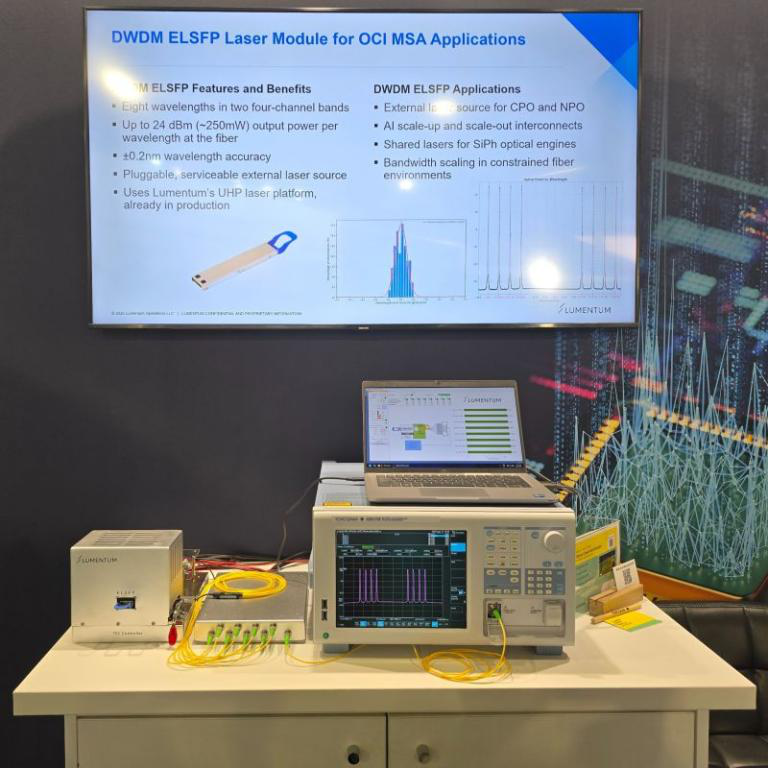
External lasers hold significant value in first-generation NPO/CPO architectures because they separate temperature-sensitive laser sources from the vicinity of high-heat-density compute chips while retaining independent maintenance and replacement capability.
Morgan Stanley further judges that first-generation NPO/CPO designs will most likely adopt high-power external lasers, with laser type and placement potentially changing in subsequent product generations; the report also expects demand for high-power CW lasers to grow significantly. [3]
Another potential commercialization signal for Lumentum is that the company is believed to be likely to announce an NPO-related LTA in the coming months.
This assessment comes from Morgan Stanley's summary of company discussions during ECOC, in which the report notes that Lumentum has discussed the possibility of announcing an NPO-related long-term agreement in the coming months. [3]
XPO offers another path: raising bandwidth density and liquid-cooling capability while retaining the pluggable form factor.
Arista released the XPO MSA in March 2026, defining a 64-channel, 12.8Tbps liquid-cooled pluggable module with a target front-panel bandwidth density of 204.8Tbps per OCP rack unit — four times that of 1600G-OSFP — and supporting up to 400W of cooling per module via an integrated cold plate. [17]
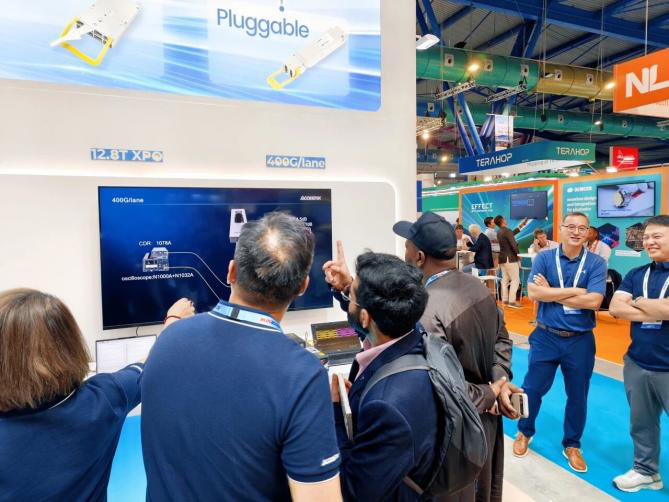
Accelink's 12.8T XPO liquid-cooled pluggable optical module showcased at ECOC 2026 further combines high density, low power, and on-site maintenance in an actual product demonstration.
The solution adopts a 64×200G PAM4 and LRO architecture, with a single-module bandwidth of 12.8Tbps equivalent to eight 1.6T modules, and supports on-site module replacement through a liquid-cooling structure and quick-connect design. [18]
As optical interconnect demand enters the stage of actual procurement and capacity expansion, upstream key materials and components begin to become important factors affecting product volume ramp-up.
Morgan Stanley lists InP substrate as the current primary gating item, and points out that its impact has already covered multiple product segments including EML, CW laser, pump laser, and gold box. [3]
The reason InP has become a key bottleneck is related to the simultaneous increase in demand for high-speed lasers, modulators, and detectors from next-generation high-speed optical modules and NPO/CPO.
Coherent's InP platform covers 200G EML, 400G/lane differential EML, 200G/400G photodiode, and 400mW-class high-power CW laser; Lumentum uses its InP platform for CW and UHP lasers. [19][20]

Locking up upstream capacity is becoming a practical reality across the optical communications industry chain.
AXT signed an InP wafer supply and capacity-reservation agreement with Lumentum through the end of 2031, with Lumentum paying a first installment of US$43.5 million; Sumitomo Electric, meanwhile, plans to grow InP substrate capacity by about 2.4 times from 2023 to 2028. [5][6]
Supply tightness also gives suppliers of EMLs, CW lasers, and other critical components stronger order visibility, while simultaneously constraining the ramp speed of some system vendors.
Morgan Stanley believes most optical component and system vendors are already sold out for the next 12–18 months, while Cisco and Nokia still have some supply capacity to release; it also judges that this supply advantage will not directly translate into significant line-system share changes in the short term, with Ciena retaining the dominant share in line systems. [3]
Changes at the materials level more strongly reflect the long-term technology needs of next-phase high-density optoelectronic systems.
The official ECOC 2026 agenda brings Silicon Photonics, heterogeneous integration, 3D assembly, glass substrates, and advanced materials into the AI interconnect program; Coherent additionally showcased Thermadite, diamond-based solutions, and SiC-related materials to address thermal constraints arising from rising power density in AI infrastructure. [21][22]
The official ECOC 2026 agenda incorporates Silicon Photonics, heterogeneous integration, 3D assembly, glass substrate, and advanced materials into the AI interconnect theme. Coherent also demonstrated Thermadite, diamond-based solutions, and SiC-related materials to address thermal constraints after AI infrastructure power density increases. [21][22]

Changes in silicon photonics also extend from device technology into integration and manufacturing systems.
ECOC 2026 discussed silicon photonics applications in scale-up and scale-out around the theme "Silicon Photonics at Every Layer," while also featuring topics such as heterogeneous-integrated silicon photonics, advanced 3D assembly, and volume manufacturing of large-scale silicon photonic interconnects. [21]
Advanced packaging is becoming the shared platform connecting optics, electronics, thermal, and manufacturing.
The official ECOC topic "Co-Packaging on Glass Substrates: Design, Materials, Processes, Equipment, and Scaling" already places materials, processes, equipment, and scaling within the CPO discussion; the related Market Focus also specifically addressed NPI, yield, reliability, and volume production in high-capacity photonic packaging manufacturing. [21][22]
The meaning of the supply chain is therefore no longer limited to "a certain material's price rising" or "a certain component being out of stock"; it now directly affects the actual ramp pace of technology roadmaps. InP, EMLs, and CW lasers are closer to realistic supply constraints today, while SiPh, SiC, diamond, glass, and advanced packaging correspond more to next-phase technology-capability building.
As optical channel count and bandwidth density continue to rise, connectivity, optical circuit switching, testing, and reliability are becoming critical to scaled deployment of AI infrastructure.
At ECOC 2026, Molex released the VersaBeam Mini, an ultra-compact 16-fiber expanded-beam connector with an approximately 3.5×9mm VSFF footprint that triples connection density versus the VersaBeam 16, supports up to 3,456 fibers in a standard 1RU panel, and claims deployment and maintenance costs can be reduced by up to 85%. [23]
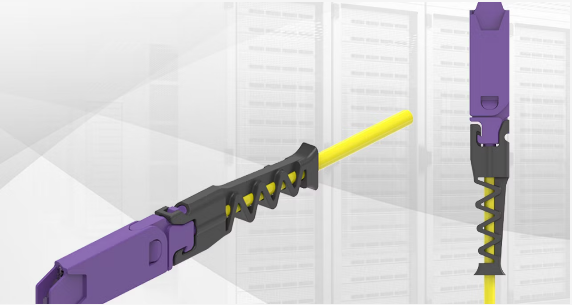
Corning, US Conec, and SENKO, meanwhile, improve high-density connectivity through expanded-beam, TMT ferrule, and VSFF structure approaches, respectively.
Corning's MMC uses the PRIZM TMT expanded-beam solution, using non-contact coupling to reduce the impact of contamination and field operations on connection quality; US Conec continues to advance 16/8/4-fiber TMT solutions; and SENKO's SN-MT16 adopts a single-row 16-fiber structure to raise connection density for high-density patching scenarios. [24][25]
Multicore fiber, for its part, raises per-fiber channel capacity from the fiber itself.
At ECOC 2026, Corning showcased a four-core multicore fiber that integrates four independent cores within a standard 125µm cladding, delivering four times the capacity of a conventional single-core fiber per fiber, and can reduce connector count by up to 75% and installation time by up to 60%. [24]
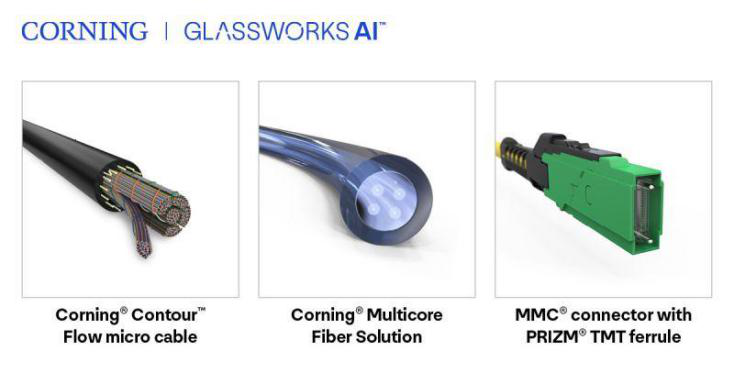
As CPO enters mass production testing, detachable connections and automated testing begin to become part of packaging design.
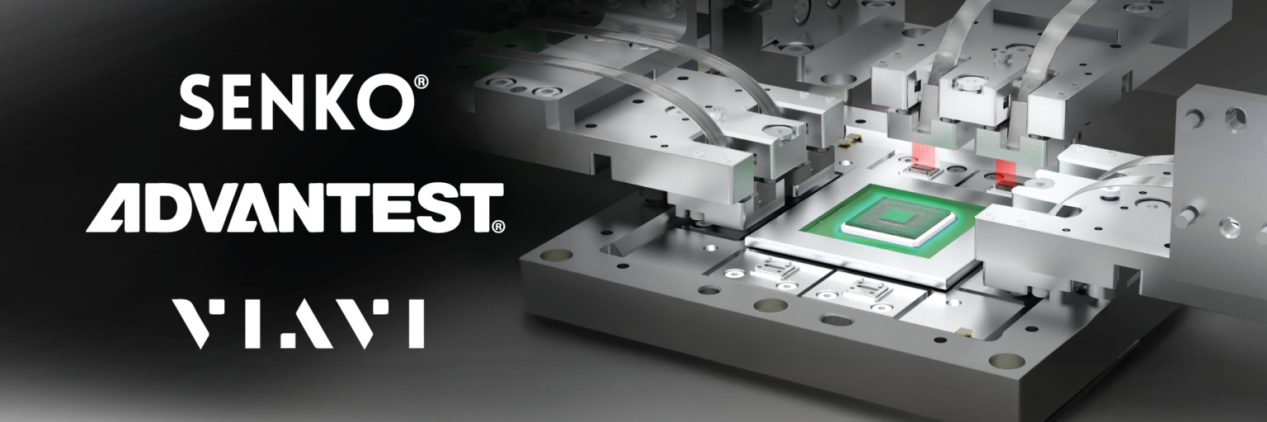
SENKO, Advantest, and VIAVI jointly demonstrated a CPO module mass production testing solution at ECOC 2026, transmitting 200Gbps/lane signals through a detachable optical interface and performing BER testing; VIAVI also demonstrated end-to-end testing capabilities covering CPO, silicon photonics, 1.6T and above networks, and AI Fabric. [26][27]
Reliability is shifting from a single-component metric to a system-operational metric for large-scale AI clusters.
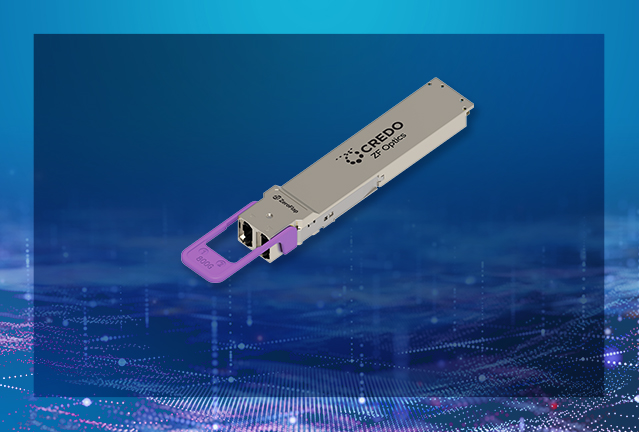
At ECOC 2026, Credo showcased its ZeroFlap optical interconnect solution and, around the theme "Scaling Optical Reliability with Bandwidth Across AI Clusters," discussed link stability and diagnostic capabilities at 1.6T and above. [28]
“Even a single unstable optical link can disrupt distributed workloads, lower resource utilization, and slow the deployment of AI services.” [28]
Optical circuit switching, meanwhile, represents another path at the network level to reduce power, cost, and OEO conversions.
Cignal AI noted at the ECOC 2026 Market Focus that OCS has moved beyond the early-experiment and limited-deployment stage, with Google's production deployment based on its TPU architecture being the clearest large-scale commercial case to date. [29]
“Optical Circuit Switching has moved beyond the science experiment / limited deployment phase, primarily based on Google integrating the technology into its TPU-based architecture.” [29]
OCS applications beyond Google remain in an early expansion stage, with significant differences in customer count and deployment scale.
Morgan Stanley's ECOC research finds that nearly all other hyperscalers and neoclouds are trialing OCS, but subsequent deployment scale may be significantly smaller than Google's; it also mentions customers that cancelled implementations after completing solution qualification, indicating that the market size beyond Google still needs further validation.
Connections and OCS therefore both serve high-density AI networks, yet they are at different industrialization stages: high-density connectivity has entered a clear productization and deployment-optimization phase, while OCS, after establishing leading-customer scale cases, continues to seek broader application scenarios.
As AI computing resources span multiple clusters and data centers, optical interconnect demand further expands from high-density connection to long-distance transmission, network reliability, and multi-vendor collaboration.
Cisco/Acacia's 800ZR/800ZR+ coherent pluggable products target AI data center interconnect and DCI scenarios, with 800ZR supporting 800G coherent transmission and 800ZR+ targeting longer-distance amplified DWDM links; Marvell discussed next-generation coherent pluggable technology around Scale Across Architectures at ECOC 2026. [7][30]
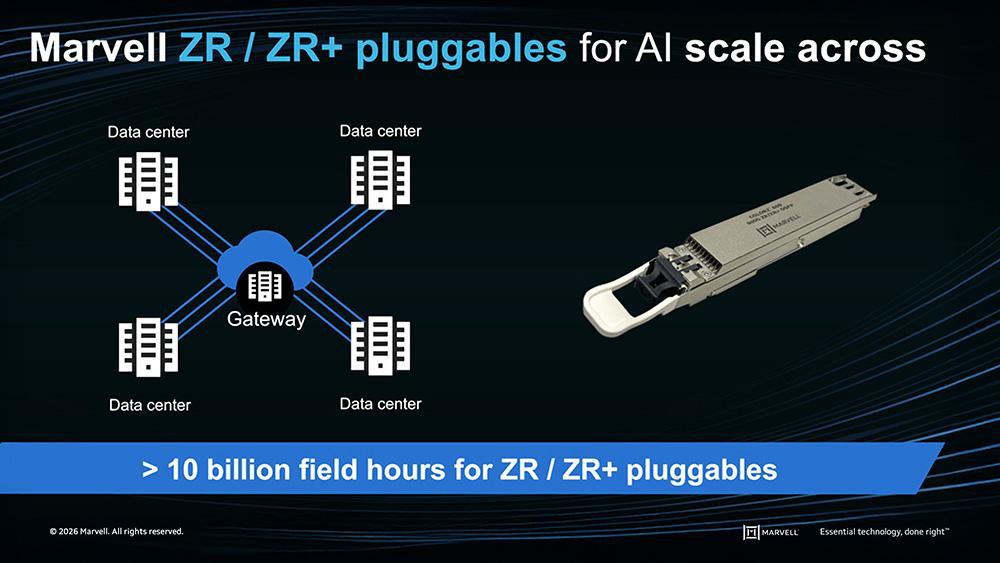
Coherent pluggables are becoming an important optical form factor for AI scale-across scenarios.
At ECOC 2026, Coherent showcased the LS200 full C-band pluggable optical line system for DCI and scale-across applications, supporting up to 32 DWDM wavelengths and up to 25.6Tbps per fiber pair across 2–200km links. [14]
Distributed AI further raises optical network requirements for fast restoration, monitoring, and service continuity.
At the ECOC 2026 Market Focus, China Telecom discussed "Carrier-Grade Optical Networks for Distributed AI Computing: From DCI to Reliable AI Interconnect," covering DWDM/OTN, ROADM/WSON fast restoration, network monitoring, and AI-assisted network planning, and brought sub-50ms network restoration into the technical discussion on distributed AI networks. [4]
At the same time, standardization is extending from traditional high-speed interfaces to optical engines and AI system-level interconnect.
At ECOC 2026, OIF organized 39 member companies to conduct multi-vendor interoperability demonstrations covering 224G/448G CEI, CMIS, 100G/400G/800G, 400ZR/800ZR, and Co-Packaging, focusing on verifying real-world interoperability among different vendors' equipment and interfaces. [31]

Open CPX, XPO, and OCI correspond to three new industry-coordination layers: CPO/NPO, high-density pluggables, and AI scale-up, respectively.
Open CPX was initiated by six founding members — Ciena, Coherent, Marvell, Molex, Samtec, and TeraHop; the XPO MSA is driven by Arista, forming a new ecosystem around 12.8Tbps liquid-cooled pluggables; and OCI was co-founded in March 2026 by six founding members — AMD, Broadcom, Meta, Microsoft, NVIDIA, and OpenAI — to establish open optical interconnect specifications for AI scale-up. [12][17][32]
The value of an open ecosystem lies in reducing hyperscalers' dependence on single vendors and closed architectures, while providing a multi-vendor supply base for complex optical interconnects.
Morgan Stanley believes that, following the push from Open CPX, customer concerns about NPO supplier lock-in have eased; at the same time, as different architectures evolve in parallel, testing and connectivity suppliers such as Keysight and Corning are relatively less dependent on any single final technology roadmap, while Lumentum and Coherent are more exposed to InP supply and external high-power laser demand. [3]
As a result, the competitive landscape of the optical interconnect industry is showing distinctly different drivers across segments.
High-speed chips and DSPs are constrained by per-channel rates and signal integrity; CPO/NPO/XPO are influenced by power, density, thermal, and maintenance conditions; laser suppliers such as Lumentum and Coherent are driven more by InP and high-power laser demand; and companies such as Keysight and Corning are more likely to benefit from the testing and connectivity demand created jointly by different architectures. [3]
The core signal from ECOC 2026 is that AI compute growth is pushing optical interconnect from "technology evolution" toward "industry restructuring." Demand growth is propagating to lasers, optical engines, advanced packaging, connectors, and testing, while NPO, CPO, XPO, LPO/LRO, and next-generation coherent pluggable solutions are evolving in parallel around different distance, power, and deployment conditions.
Even more notable is that the yardstick of industry competition is changing. A technical demo is only the starting point; what truly determines whether a roadmap can be deployed will be customer validation, volume-production ramp, supply-chain security, and scaled-delivery capability. From this perspective, ECOC 2026 showcased not just next-generation products but a staged transition of the optical interconnect industry from "competing on specs" to "competing on deployment."
Over the next 12–24 months, the industrialization progress of NPO/CPO, the supply capability of critical materials and lasers, and whether different architectures can form stable, scalable business models will be the key indicators for tracking the next phase of AI optical interconnect development.
[1] ECOC Exhibition. What's on at ECOC 2026. 2026. https://www.ecocexhibition.com/whats-on/
[2] ECOC 2026 Conference. Plenary Speakers — Peter Winzer: AI Cluster Communications. 2026. https://ecoc2026.org/ECOC2026/programme/plenary-speakers_
[3] Hilo Research. Morgan Stanley ECOC 2026 Optical Interconnect Ecosystem for AI Networks: ECOC Points to a 2028 NPO Trial Cycle Amid Tight Optical-Component Supply. September 23, 2026.
[4] ECOC Exhibition. Market Focus Session Information. 2026. https://www.ecocexhibition.com/visit/market-focus/market-focus-session-information/
[5] AXT, Inc. AXT Announces Long-Term Supplier Agreement with Lumentum. July 29, 2026. https://investors.axt.com/Investors/news/news-details/2026/AXT-Inc--Announces-Long-Term-Supplier-Agreement-with-Lumentum/default.aspx
[6] Sumitomo Electric Industries, Ltd. Data Center Related Business Growth Strategy. November 13, 2025. https://sumitomoelectric.com/jp/sites/japan/files/2025-11/download_documents/20251113ceo_data.pdf
[7] Marvell Technology. Marvell to Showcase Industry-First 2nm Optical Technology Demos for AI Data Center Infrastructure at ECOC 2026. September 20, 2026. https://www.marvell.com/company/newsroom/marvell-industry-first-2nm-optical-technology-ai-data-center-infrastructure-ecoc-2026.html
[8] Semtech. Semtech Launches 224Gbps IC Family for Linear Optics Era. March 16, 2026. https://investors.semtech.com/news/semtech-launches-224gbps-ic-family-for-linear-optics-era/62c77c81-5f0a-41d9-a64c-5f760a6a6df0
[9] MACOM Technology
[10] Credo. Credo Demonstrates 1.6T 2xDR4 Fully Retimed Module at ECOC 2026. 2026.
[11] Sicoya. Sicoya Demonstrates 400G/lane PIC and 1.6T-Class Optical Solutions at ECOC 2026. 2026.
[12] Open CPX. Open CPX MSA. 2026. https://www.open-cpx.com
[13] Ciena. Ciena Vesta 200 6.4T CPX. 2026. https://www.ciena.com
[14] Coherent. Coherent Launches PhotonLink™ Integrated Optical Platform. September 21, 2026. https://www.coherent.com
[15] Coherent. PhotonLink Investor Materials. 2026.
[16] Lumentum. Lumentum Demonstrates 8-Wavelength DWDM ELSFP at ECOC 2026. 2026. https://www.lumentum.com
[17] Arista. XPO MSA. March 2026. https://www.arista.com
[21] ECOC 2026 Conference. Silicon Photonics at Every Layer. 2026.
[22] ECOC 2026 Conference. Co-Packaging on Glass Substrates: Design, Materials, Processes, Equipment, and Scaling. 2026.
[23] Molex. Molex Releases VersaBeam Mini Ultra-Compact 16-Fiber Expanded Beam Connector. 2026. https://www.molex.com
[24] Corning. Corning MMC with PRIZM TMT. 2026. https://www.corning.com
[25] US Conec. US Conec TMT Solutions. 2026. https://www.usconec.com
[26] SENKO. SENKO, Advantest, and VIAVI Jointly Demonstrate CPO Module Mass Production Testing. 2026. https://www.senko.com
[27] VIAVI. VIAVI End-to-End Testing for CPO, Silicon Photonics, 1.6T and Above. 2026. https://www.viavi.com
[28] Credo. Credo ZeroFlap Optical Interconnect Solution. 2026. https://www.credosemi.com
[29] Cignal AI. ECOC 2026 Market Focus: Optical Circuit Switching. 2026.
[30] Cisco/Acacia. 800ZR/800ZR+ Coherent Pluggable. 2026. https://www.acacia-inc.com
[31] OIF. OIF Multi-Vendor Interoperability Demonstrations at ECOC 2026. 2026. https://www.oiforum.com
[32] OCI MSA. OCI MSA Founding Members. March 2026.